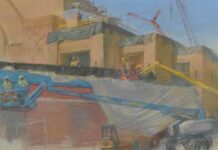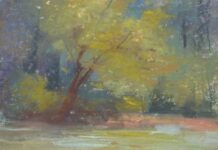

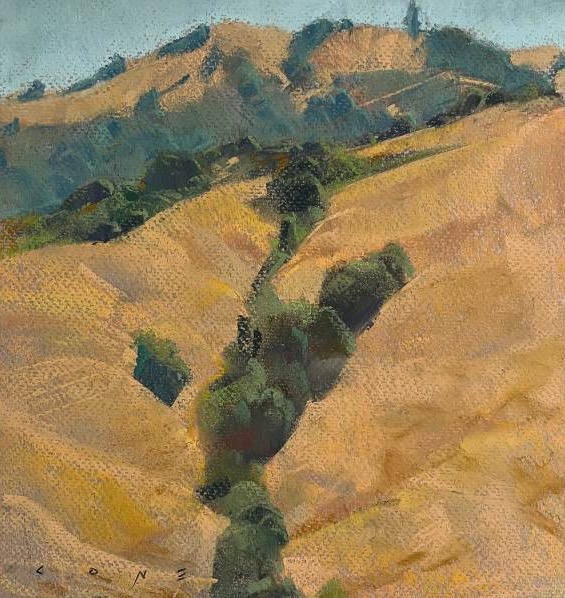
Bill Cone paints within 15 miles of San Francisco Bay — a landscape that shifts dramatically through the seasons, from the brilliant green grasses of spring to the golden brown hills that hold until the winter rains return, all of it softened by the haze and moisture that drift in from the coast.
“When I first started working outside, it was the atmosphere that intrigued me,” he says. “The fact that you could line up trees in the foreground with more distant ones, and see a clear shift in value and temperature in the distance — it began to sink in that the colors of a scene were subject to a variety of circumstances, one of them being the distance from my position.”
His Go-To Pastel Stick: Terry Ludwig Eggplant (V100), a dark shade of violet, is Cone’s pick for rich darks. “It’s a shadow within a shadow sort of thing that still has a sense of color temperature,” he explains. “Violet is flexible because it contains both warm and cool — red and blue — so it can lean either direction depending on what surrounds it.” He uses it as an accent in higher-key pieces, as a mass of dark form in shadow, or to push an image’s dynamic range when his work trends too light. “A little can go a long way,” he notes.
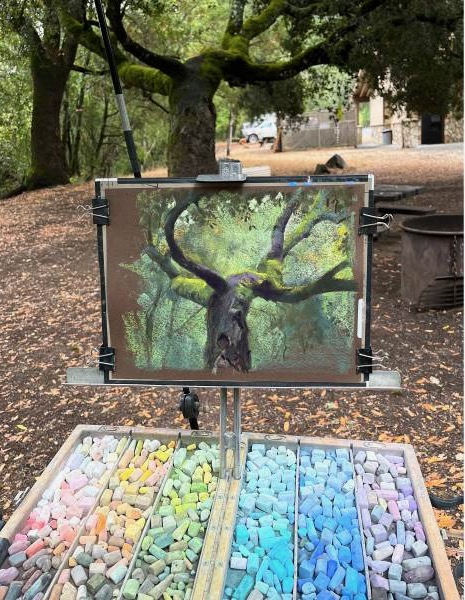
Other Colors He Can’t Live Without: Cone thinks in terms of ranges rather than specific sticks — warm and cool versions of each hue across a full value range. Blues and greens cover atmospheric haze on distant hills, ocean water in different light, and the greens of coastal oaks, redwoods, and grasses. For the golden hills that dominate nine months of the year, he maintains a range of ochres, oranges, and light browns, along with their cooler, darker shadow counterparts. For skies, he pushes gradients toward pale turquoise near the horizon and ultramarine at the zenith — a habit carried over from his years at Pixar. “Some accused me of making my skies green,” he says.
For Cone, the goal is never to have exactly the right color — it’s to have enough options to keep layering and adjusting until the relationships feel right. “The weather, time of day, and seasons have a powerful effect on colors and values,” he says. “Local color is subject to these conditions, so there’s not a fixed hue or value. A red barn is never the same color, even if it appears ‘red’ relative to other elements in the scene.”