
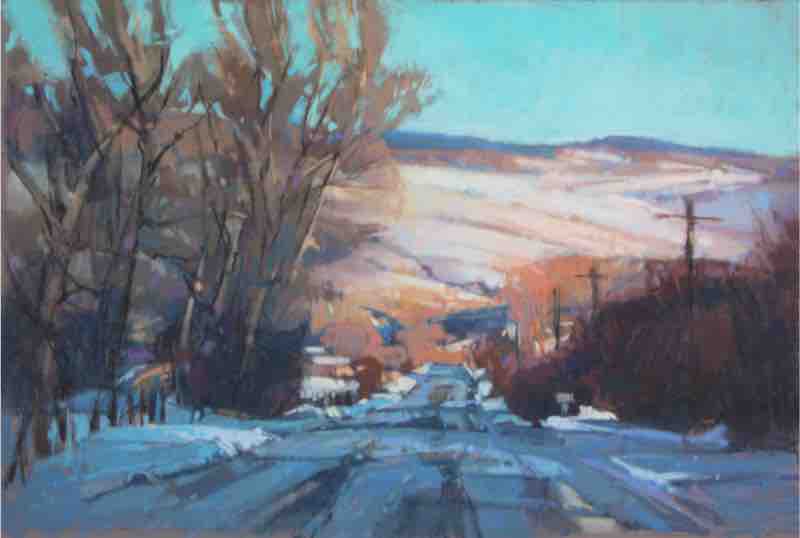
For me, inspiration begins with the sheer joy of being outdoors. I love immersing myself in nature, hiking in the quiet solitude far from the bustle of the city where I now live. I’m especially drawn to wide-open spaces, where I can lose myself in the ever-changing sky. The movement, shapes, and shifting colors of the clouds never fail to excite me. In particular, I like to go out at dusk, when the sky ignites with shades of pink, orange, and violet; shadows grow longer, and the earth’s colors deepen into a richer palette.
By observing nature directly, I’m able to explore the subtle nuances and color harmonies within the landscape. While I take reference photos and occasionally create color studies on site, I often rely on a simple pencil sketch to capture what I see. I distill the landscape into simple shapes, focusing on the most important elements, and aim to convey the overall feeling or mood of the scene.
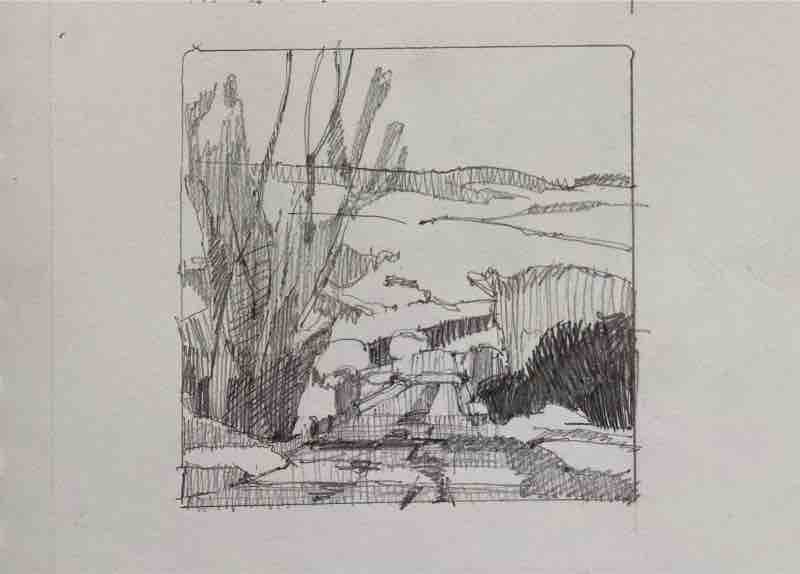
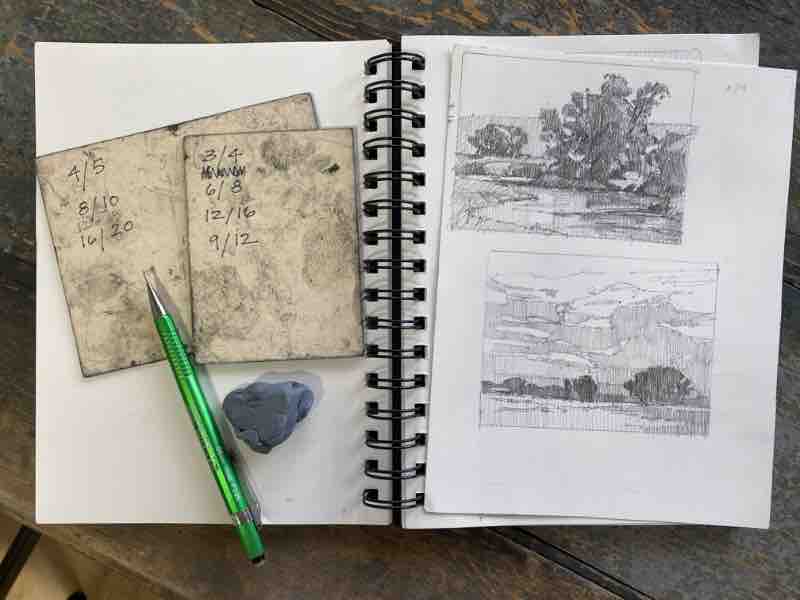
Working in black and white with graphite allows me to better identify value patterns and mass them together for a stronger, more unified statement. Most of my thumbnail sketches are 3 x 4 inches, while the square ones measure 3 x 3. Keeping them small and squinting as I work helps me focus on the big shapes and eliminate unnecessary details. More than anything, the tiny thumbnails serve as a crucial tool for refining composition. Back in the studio, these on-site sketches guide my decisions on cropping the scene from my reference photos and remind me of what initially drew me to the subject.
Planning the Path to the Focal Point
My goal with the sketch above [Evening Glow thumbnail sketch] was to work out the strongest composition and layout for a painting. I initially envisioned the piece as a square, but after completing the sketch, I realized a rectangular format would better allow me to expand the surrounding shadows. As you can see in the finished painting at top [Evening Glow], the wider layout also helps guide the viewer’s eye back to the sunlit glow of the background trees — the focal point of the piece.
Capturing Movement and Mood
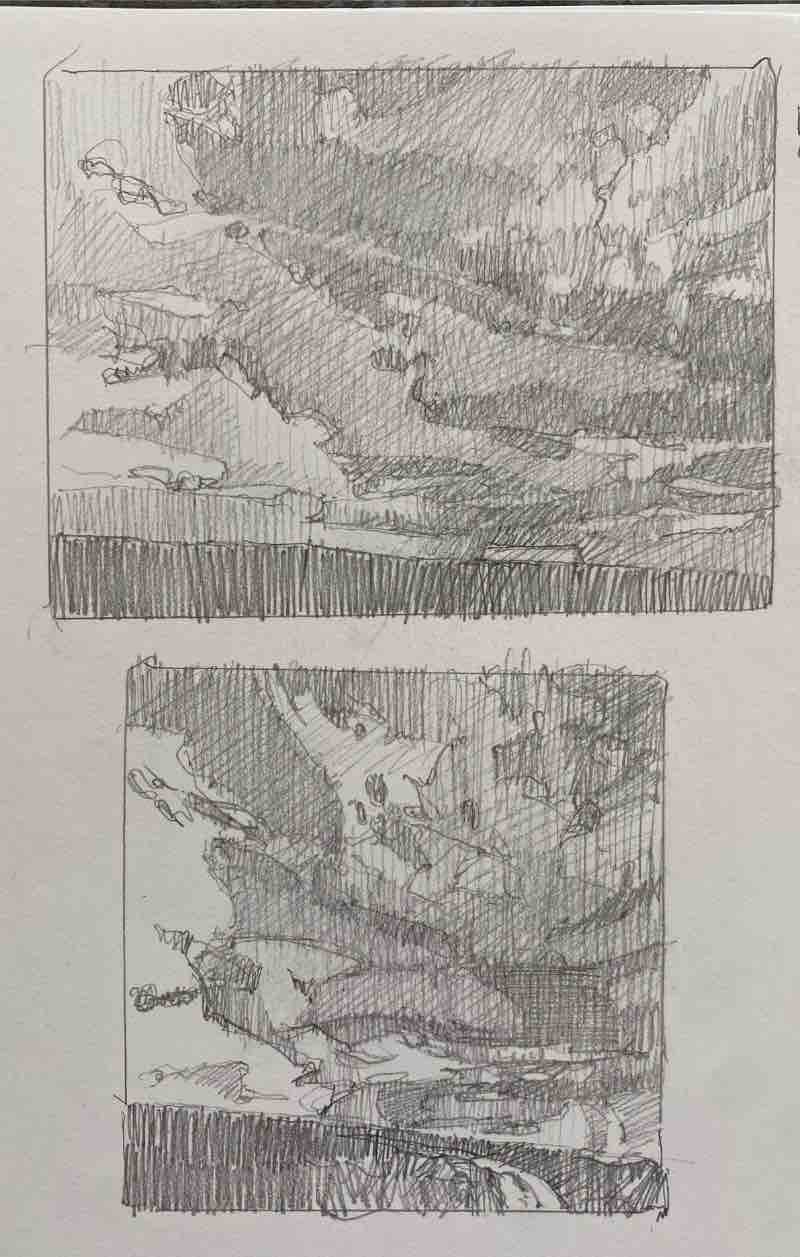
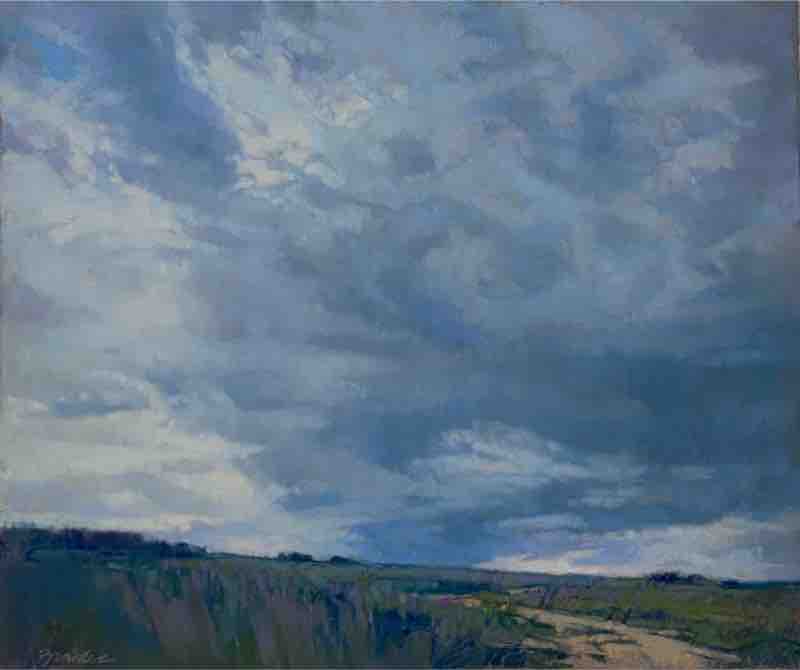
I quickly made two field sketches as storm clouds rolled in over the hill — hence the title [Approaching]. With the clouds shifting too rapidly to capture every effect in my thumbnails, I combined the sketches with reference photos taken on-site to develop the final piece. The square format of the studio painting enhances visual tension, guiding the eye in a circular movement around the composition and reinforcing the dynamic energy of the scene.
Simple Toolkit for Sketching
- 5 1/2 x 8 1/2-inch sketchbook
- mechanical pencil
- kneaded eraser
- two cardboard pieces cut to 4 x 5 and 3 x 4 inches: I trace around the cardboard templates to create frames for pencil studies in my sketchbook. The dimensions of the frames scale proportionally to 9 x 12 or 18 x 24-inch paintings.