
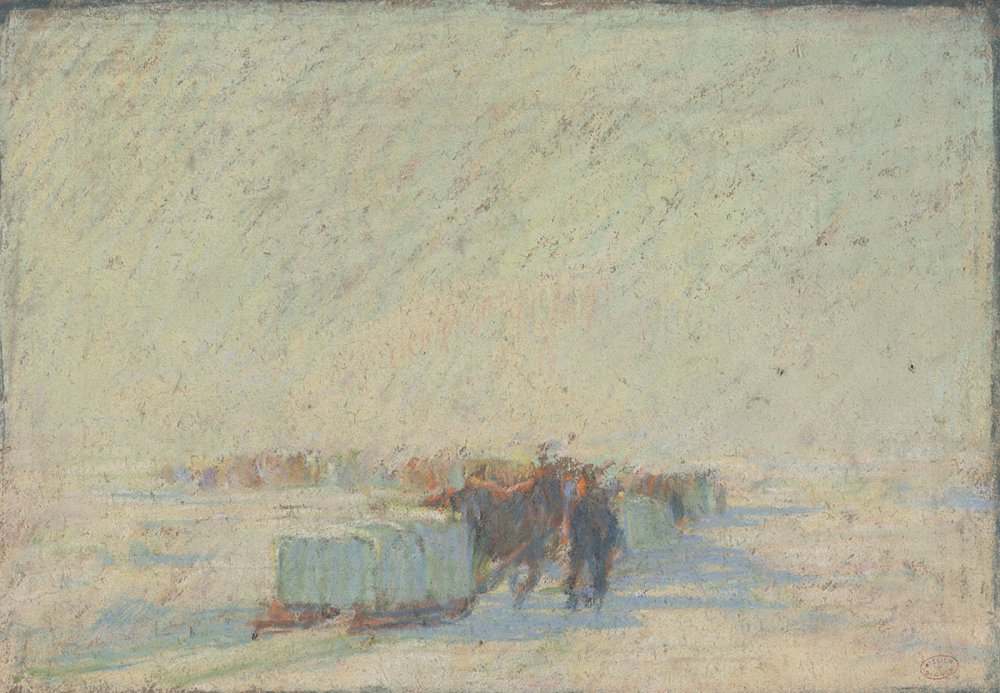
In 1920, as Canada sought to define itself in the wake of World War I, its artists were doing the same. Questions of national identity shaped the cultural landscape, and in Quebec, that search often took the form of regionalism — a reverence for rural traditions and ancestral ways of life. Clarence Gagnon’s Ice Bridge (1920), a pastel recently acquired by the National Gallery of Canada, beautifully captures that moment.
The scene is deceptively simple: a convoy of horses and sleighs crossing the frozen St. Lawrence River. Heavy blocks of ice rest on a sled in the foreground, while figures traverse the ephemeral roadway formed by winter’s grip. Ice bridges were more than seasonal phenomena; as historian Yves Hébert has noted, they were “places where the collective identity was constructed.” In Gagnon’s hands, this winter crossing becomes both document and symbol — an homage to resilience, labor, and continuity in the Quebec countryside.
“It was not the over-sensitivity of the misunderstood that made me move to Paris….Over there, I paint only Canadian subjects, I dream only of Canada. The motif remains fixed in my mind, and I don’t allow myself to be captivated by the charms of a new landscape. In Switzerland, Scandinavia — everywhere, I recall my French Canada.”
– Clarence Gagnon, 1931
Born in Montreal in 1881, Gagnon trained locally under William Brymner before continuing his studies in Paris at the Académie Julian. There, exposure to European Impressionism — and to fellow Canadian James Wilson Morrice — introduced him to a looser, more spontaneous handling of paint. That influence is evident in Ice Bridge. While its subject matter aligns with Quebec’s regionalist ethos, its softly sketched forms and luminous atmosphere reveal a modern sensibility rooted in French Impressionism.
The year of the pastel’s creation also marked the founding of Ontario’s Group of Seven, whose bold, unpeopled wilderness scenes sought to define a unified Canadian art. In contrast, Quebec regionalists like Gagnon focused on inhabited landscapes shaped by faith, agriculture, and tradition. Their vision, though quieter, was no less nationalistic — and no less complex. Gagnon himself criticized the Group’s unifying ambitions as “dictatorial,” highlighting the cultural tensions embedded within Canada’s artistic evolution.
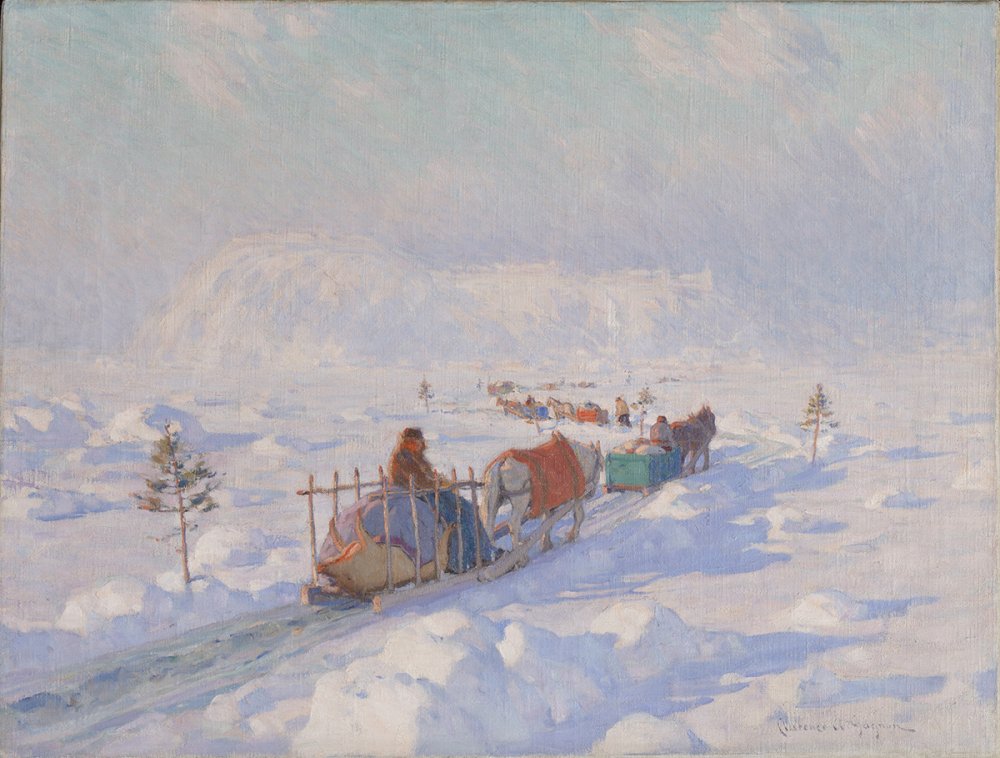
At once traditional and modern, intimate and national, Ice Bridge reminds us how powerfully pastel can convey atmosphere — and how a single winter crossing can hold the weight of cultural identity.
Put your own unique spin on winter landscapes with help from Aaron Schuerr’s Winter Sunset in Pastel.